


 United States
 Best Seller
 Label Printers
 All PDAs
 All Tablets
 All Thermal Labels
 Printer Accessories
If you handle lots of cash, you’ve probably wondered: Do money counters count fake money? Short answer: modern money counting machines don’t magically “make counterfeit bills disappear,” but many are built to detect suspicious notes while they count — and they’ll flag, stop, or separate bills that fail one or more authenticity checks. That makes them far safer than counting by hand, but not infallible. Below, this blog will explain exactly how counterfeit-detection features work, their limits, how to pick a money counting machine with the right protections, and practical tips for keeping your cash safe.
How Do Money Counting Machines Work
A basic bill counter simply feeds notes past sensors and increments a count. Models that include counterfeit detection add extra sensors and logic to test for banknote security features as each note passes through — then they either alert the operator, stop the run, eject the suspect note, or move it to a separate reject tray. These “smart” counters combine speed and simple fraud screening so businesses can count fast without blindly trusting every bill.
The Main Counterfeit-Detection Technologies Inside Bill Counters
Money counters use one or more of these detection systems. Machines that combine several methods are safest.

- Ultraviolet (UV) detection — Many currencies include fluorescent inks or security threads that glow under UV light. UV sensors check whether the expected fluorescence exists and matches the pattern for a genuine bill. Fast and common, UV is often the first line of defense.
- Magnetic (MG) detection — Genuine banknotes often contain magnetic ink or particles in certain printed areas. Magnetic sensors detect the presence (and sometimes the pattern) of those magnetic elements. MG detection is useful because many counterfeiters don’t reproduce magnetic inks correctly.
- Infrared (IR) detection — Some bills use IR inks or printed patterns visible only under infrared light. IR detection checks for the unique IR reflectance/absorption profile of authentic notes and can be especially hard for counterfeiters to mimic.
- Size / thickness / material checks — Sensors can measure a bill’s physical dimensions, thickness, and even the way light transmits through the paper. Many counterfeits differ in size, weight, or substrate, so this is an effective mechanical check.
- Watermark / thread and microprint checks — Advanced counters can detect embedded security threads or test for known watermark patterns; some high-end machines also scan for microprinting and other fine features. Together, these make detection more robust.
- Serial-number / image recognition (AI/optical) — Top-tier currency sorters and counterfeit detectors can optically read and analyze printed patterns or serial numbers to find anomalies. These systems are more common in professional bank-grade machines.
Many reputable machines, like some high-level MUNBYN’s bill counting machines, combine UV + MG + IR + size checks so that a note that slips past one test is likely caught by another. That multi-layer approach is why modern counters are dramatically more reliable than manual inspection.
So — Will a Money Counter “Count” Fake Money?
A bill counter will still pass a counterfeit bill through its counting mechanism (it must, to check it), but if the device’s detection sensors deem the bill suspicious, it will typically:
- Flag the note (error message or flashing light),
- Pause or stop the count, and/or
- Divert the bill to a reject tray (some high-level bill counting machines have two pockets) for manual review.
That means the machine counts the physical bill but alerts you so you don’t accept it as valid cash in your totals. In practice, that’s exactly what you want: speed plus a safety net.
Important Limitations You Should Pay Attention To
No device is 100% foolproof. Here are common real-world failure modes:
- Sophisticated counterfeits: High-quality forgeries can replicate some security features well enough to pass basic sensors. Criminals follow the tech, so detection must keep evolving.
- Worn or dirty genuine notes: Old, heavily circulated bills may have faded UV inks or worn threads and can be falsely flagged. Conversely, a very new counterfeit (with crisp features) might trick some checks.
- Currency and country differences: A machine tuned for USD features may not reliably detect counterfeits in other currencies unless it’s designed for multi-currency support. Make sure the model supports the currencies you handle.
- Single-method machines: Low-cost counters that only use UV — or only size checks — are easier to bypass than multi-sensor units.

Choosing the Right Money Counting Machine
If your priority is minimizing counterfeit risk, here’s what to check:
- Multiple detection methods — Look for UV + MG + IR + size (mixed-detection machines).
- Multi-currency support — If you handle more than one currency, confirm the machine recognizes and tests those specific denominations.
- Reject tray + alarm — A physical separation for suspect notes plus an audible/visual alert speeds review and prevents accidental mixing.
- Software updates & service — The ability to update detection firmware or maintain the sensors helps keep the machine useful as new counterfeiting techniques emerge.
- Value-counting & mixed-denomination features — If you need the machine to total dollar values (not just counts) or sort mixed denominations, pick a model with those capabilities.
Recommended Practices for Businesses that Handle Cash
- Use a multi-sensor machine — it’s the best bang for your fraud-reduction buck.
- Don’t rely on machines alone — train staff to feel and visually inspect suspicious notes (texture, watermark, security thread), and keep a handheld UV pen or standalone detector for verification.
- Set up a workflow for rejects — decide who inspects, logs, and reports suspect notes (and keep them separate from the day’s takings).
- Service and clean sensors regularly — dust and grime will degrade detection accuracy; follow the manufacturer’s maintenance guide.
- Choose the right model for your currency and volume — high-volume retail, banks, and casinos need different features than low-volume small businesses.
What About MUNBYN Money Counting Machines?
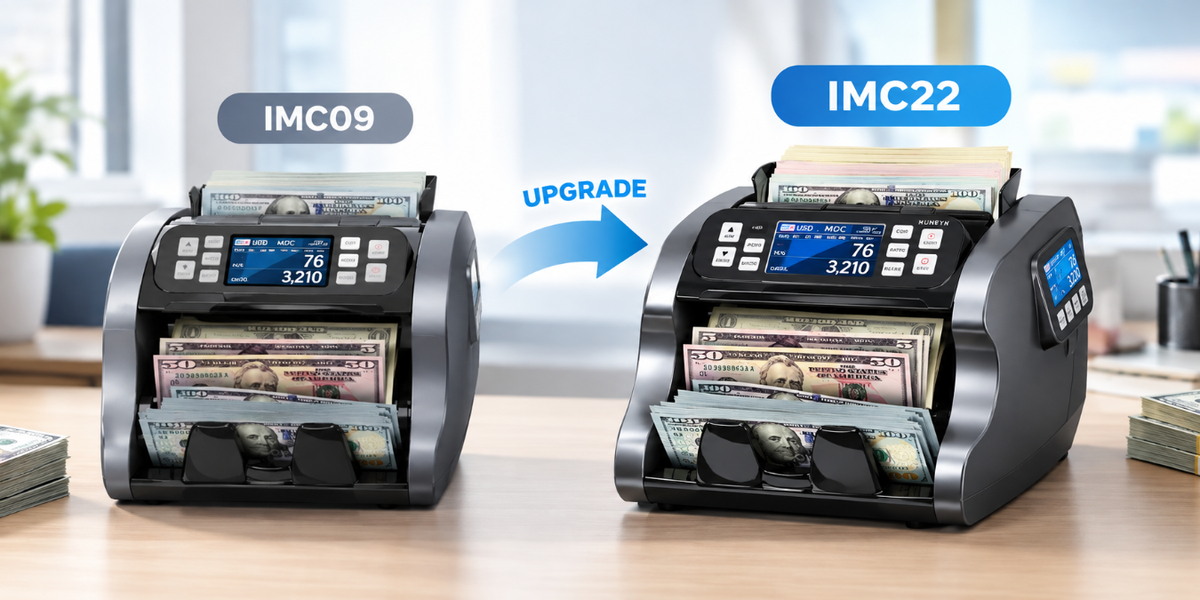
MUNBYN money counting machines are designed specifically for businesses that need fast, accurate cash handling with added counterfeit protection. While no money counter can guarantee 100% counterfeit detection, MUNBYN machines significantly reduce risk by combining multiple verification technologies with efficient counting performance.
Here’s what typically stands out about Munbyn machines:
-
Multi-layer counterfeit detection
Most MUNBYN money counting machines use a combination of UV, MG, IR, and size/thickness detection. This layered approach helps flag suspicious notes more reliably than single-method counters. -
Speed and efficiency
MUNBYN counters are built for high-speed counting, which saves time compared to manual counting while still adding a level of security. -
Good fit for small to medium businesses
Retail stores, restaurants, offices, and cash-based businesses benefit from MUNBYN’s balance of price, performance, and counterfeit detection, without needing expensive bank-grade equipment. -
Multiple models available
MUNBYN offers different money counters depending on your needs—basic counting with detection, or more advanced options with batching and value-counting features. If you’re planning to place an order, don’t forget to use the limited-time discount code “MYSEO” at checkout to enjoy an extra 8% off—easy savings with no extra steps.
Final Thoughts
Money counter machines with counterfeit detection are an essential tool for any cash-handling business. They dramatically reduce human error and the chance you’ll accept fake bills, but they aren’t a silver bullet. Buy a multi-sensor model (UV + MG + IR + size), keep machines serviced, train staff in manual verification, and treat rejected notes with a clear process. If you want to explore models that combine fast counting with robust counterfeit detection, start with the MUNBYN collection of money counters and choose a unit that explicitly lists multi-method counterfeit detection.

Share:
New Year, New Canvas: Celebrating 2026 with Creativity, Efficiency, and Renewal
Thermal Paper vs Regular Paper — What’s The Difference