


 United States
 Best Seller
 Label Printers
 All PDAs
 All Tablets
 All Thermal Labels
 Printer Accessories
If you manage warehouse operations, inventory systems, or retail logistics, you've likely encountered this decision: should your team use a handheld computer or a barcode scanner? On the surface, they seem similar—both are portable, both read barcodes, and both promise to streamline operations. But dig deeper, and you'll find critical differences that can significantly impact productivity, costs, and scalability.
This isn't a question with a one-size-fits-all answer. A retail store with 50 SKUs has different needs than a third-party logistics provider managing thousands of shipments daily. The device that works for one operation might waste money and create headaches for another.
In this guide, we'll break down exactly what distinguishes these technologies, help you understand which suits your operation, and walk through real-world considerations that industry professionals actually care about.
What's the Real Difference?
The Barcode Scanner: Narrowly Focused
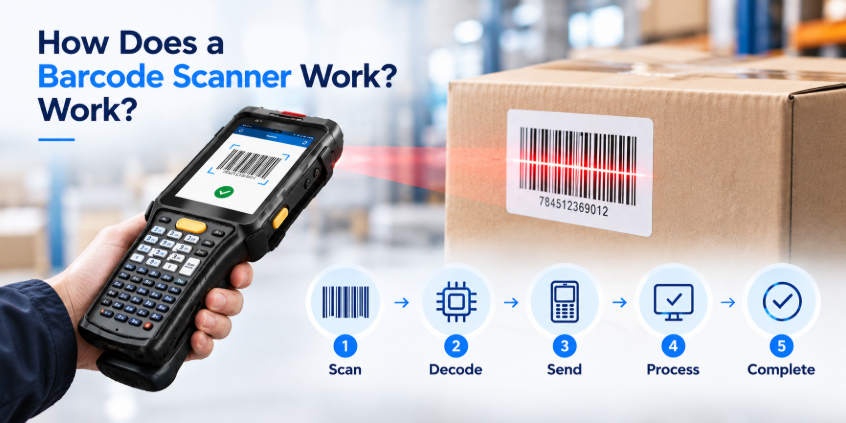
A traditional barcode scanner is a specialized device designed for one primary function: reading barcodes. That's it. Most barcode scanners are either handheld wand-style devices (like the ones cashiers use) or fixed-position readers mounted at shipping stations. They connect to a computer or existing system via cable or wireless connection and transmit data back to your software.
Key characteristics:
- Single-purpose hardware
- Minimal processing power
- Depends on connectivity to a backend system
- Lower initial cost (usually $100–$500 per unit)
- Fast, reliable barcode capture
- Limited offline functionality
The Handheld Computer: The Swiss Army Knife
A handheld computer (also called a mobile computer or Android handheld device) is a self-contained computing device. It runs an operating system, can install applications, performs data processing independently, and often has built-in barcode scanning hardware. Think of it as a rugged smartphone designed specifically for business operations.
Key characteristics:
- Multi-purpose device with processing power
- Runs dedicated business software
- Can function offline and sync when connected
- Higher initial investment ($500–$1,500+ per unit)
- Reads barcodes, QR codes, and other formats
- Enables complex workflows and data capture
- Extended battery life for all-day use
The distinction matters because it fundamentally changes how your operation works.
Why This Comparison Matters to Your Industry
Different sectors face unique operational pressures. Let's be honest about where the tension comes in:
For warehouse managers, the challenge is keeping pace with increasing order volumes while maintaining accuracy. Every misplaced item or data entry error compounds downstream. You need speed without sacrificing reliability.
For shipping and logistics professionals, the pressure is managing multi-leg shipments across different hubs and carriers. You need visibility and the ability to make real-time decisions when exceptions occur—like a package sorted to the wrong truck.
For retail operations, inventory shrinkage and cycle count accuracy eat into margins. You also need to handle returns, damaged goods, and customer interactions on the spot.
For manufacturing and field service, the challenge is different again. You're tracking assets, managing work orders, and capturing data in harsh environments. Connectivity isn't guaranteed, and workers need access to technical information on the device itself.
Barcode scanners and handheld computers serve these needs differently.
Key Comparison: Capabilities That Matter

Data Processing and Intelligence
With a barcode scanner, you scan a barcode, and it sends a string of numbers to your backend system. Your system then decides what to do. If your warehouse management system (WMS) is down or your network connection drops, you're stuck.
With a handheld computer, the device itself can make some decisions. Is this barcode valid for this location? Has this shipment already been processed? Is there a quality issue flagged for this item? The device can respond in real-time without waiting for server confirmation. When you reconnect, it syncs the data. This distinction shifts from dependency on infrastructure to operational resilience.
Application Flexibility
Barcode scanners run one application: barcode reading. Handheld computers run whatever you install. Many businesses use integrated solutions like MUNBYN's Android handheld computers, which support multiple warehouse management applications, custom workflows, and even third-party integrations. You can modify processes without purchasing new hardware.
Data Capture Beyond Barcodes
Modern operations require more than barcodes. You might need to:
- Capture photos of damaged goods
- Collect signatures on delivery confirmation
- Conduct quality inspections with checkboxes and notes
- Verify weight or dimensions
- Record temperature or environmental data
Barcode scanners can't do any of this. Handheld computers handle all of it through dedicated apps.
Real-World Application: MUNBYN Handheld Computers

To see this in practice, consider solutions like MUNBYN Handheld mobile computers. These devices bridge the gap between consumer-grade tablets and enterprise-level hardware. They're designed specifically for warehouse, retail, and logistics environments.
The typical MUNBYN handheld includes:
- Rugged industrial design built for drops and spills
- Integrated barcode/QR code scanning with 2D imaging
- Android operating system running specialized warehouse apps
- Cellular and WiFi connectivity with offline capabilities
- All-day battery life
- Competitive pricing compared to traditional enterprise solutions
For operations considering the handheld computer route, solutions like this offer flexibility without the cost of legacy enterprise systems. The advantage here is that you're not locked into one vendor's software ecosystem. Android-based devices run a variety of warehouse management applications, and you can switch platforms if your needs change.
How to Choose: A Practical Decision Framework
Choose a barcode scanner if:
- You need simple, high-volume barcode reading in fixed or semi-fixed locations
- Your budget is severely limited, and you already have robust backend systems
- Your workflow requires minimal data processing on the device
- Your operation has excellent network reliability
- Integration with existing hardware is essential
Choose a handheld computer if:
- Your operation requires multi-step workflows and decision-making
- You need offline functionality and data syncing
- You capture data beyond barcodes
- Your team needs access to information while mobile
- You want flexibility to change software without replacing hardware
- Your operation spans multiple locations or conditions
For most modern warehouse and logistics operations, a handheld computer is the right choice—even if the initial cost seems higher. The productivity gains, reduced errors, and operational flexibility typically offset the investment within 6–12 months.
Common Questions Our Customers Ask
Q1: Is a handheld computer the same as a barcode scanner?
A: No. A barcode scanner is a single-purpose device for reading barcodes. A handheld computer is a versatile device that includes barcode scanning plus computing capabilities. A handheld computer can replace a barcode scanner, but not vice versa.
Q2: Can handheld computers scan barcodes?
A: Yes, all modern handheld computers include integrated barcode scanning hardware. MUNBYN mobile computers can read 1D codes, 2D codes, and QR codes. (Use the limited-time discount code "MYSEO6" at checkout to enjoy an extra 6% off.)
Q3: Can a Handheld Computer Replace a Barcode Scanner?
Yes, functionally. Any modern handheld computer includes barcode scanning hardware. However, "replace" depends on context. If you're asking whether a handheld computer can read barcodes—absolutely. If you're asking whether it's the right choice for your specific operation, that requires deeper analysis. For simple, high-volume scanning in a fixed location (like checkout), a dedicated barcode scanner might be faster and cheaper. For complex workflows requiring decision-making and data collection, a handheld computer is the only realistic option.
Q4: What is the best device for barcode scanning and inventory management?
A: For most operations, a handheld computer running dedicated inventory management software provides the best balance of capability, accuracy, and productivity.
Q5: What Can a Handheld Computer Do That a Barcode Scanner Can't?
- Process data locally without network connectivity
- Run business logic and conditional workflows
- Capture data beyond barcode numbers (images, signatures, notes)
- Access historical data and reference information
- Support multiple concurrent users on different tasks
- Integrate with multiple backend systems
- Provide worker guidance and real-time instructions
Implementation Considerations
Cost of Ownership vs. Purchase Price
Yes, a handheld computer costs more upfront. But calculate total cost of ownership:
- A barcode scanner costs $300, but requires a separate terminal or computer ($2,000+)
- A handheld computer costs $1,000 but operates independently
- Over 3 years with maintenance and support, costs converge
- Add in reduced errors and faster processing, and handheld computers typically cost less overall
Training and Adoption
Handheld computers have a steeper learning curve, but modern interfaces are intuitive for most workers. Budget time for onboarding. Barcode scanners are instantly familiar to most people, but that familiarity creates a false sense of simplicity.
Integration with Existing Systems
This is where many operations struggle. A barcode scanner is a dump truck—it sends data and expects something to receive it. A handheld computer can be a two-way partner with your backend systems. Make sure your software supports integration.
The Bottom Line
The barcode scanner didn't disappear; it evolved. That evolution led to handheld computers—devices that do everything a barcode scanner does and much more. For operations ready to move beyond simple data capture to intelligent workflow management, the investment is worth it.
For most warehouse, retail, and logistics operations, a handheld computer is a better long-term investment than a dedicated barcode scanner. The flexibility, processing power, and ability to function offline create operational resilience that a barcode scanner simply cannot provide.
That said, the best device is the one that matches your specific operation. A small retail checkout location might never need that computing power. A multi-location warehouse running complex workflows absolutely does.
Share:
Personalized Sticker Ideas for Kids: 15 Creative Ways to Keep Little Ones Busy
Why Is My Label Printer Printing Blank? A Complete Troubleshooting Guide