


 United States
 Best Seller
 Label Printers
 All PDAs
 All Tablets
 All Thermal Labels
 Printer Accessories
Retail businesses handle cash every day, from processing customer payments to preparing bank deposits and reconciling registers at closing time. As transaction volumes grow, manually counting bills can take valuable time, increase the risk of counting errors, and make end-of-day cash management more complicated.
The best money counter for retail businesses depends on how much cash you process, whether you need to calculate mixed denominations, and how important counterfeit detection is to your daily operations. A small boutique may need a straightforward bill counter, while a supermarket, convenience store, or multi-location retailer may benefit from a professional mixed-denomination money counter.
This guide explains the features retailers should prioritize, compares different types of cash counting machines, and explores how MUNBYN and Cassida serve different cash-handling needs.
What Is the Best Money Counter for Retail Businesses?
For retailers that regularly handle mixed denominations, a money counter that calculates total cash value, checks banknotes for suspicious features, and supports batch counting is often the most practical choice. Two MUNBYN models worth considering are:
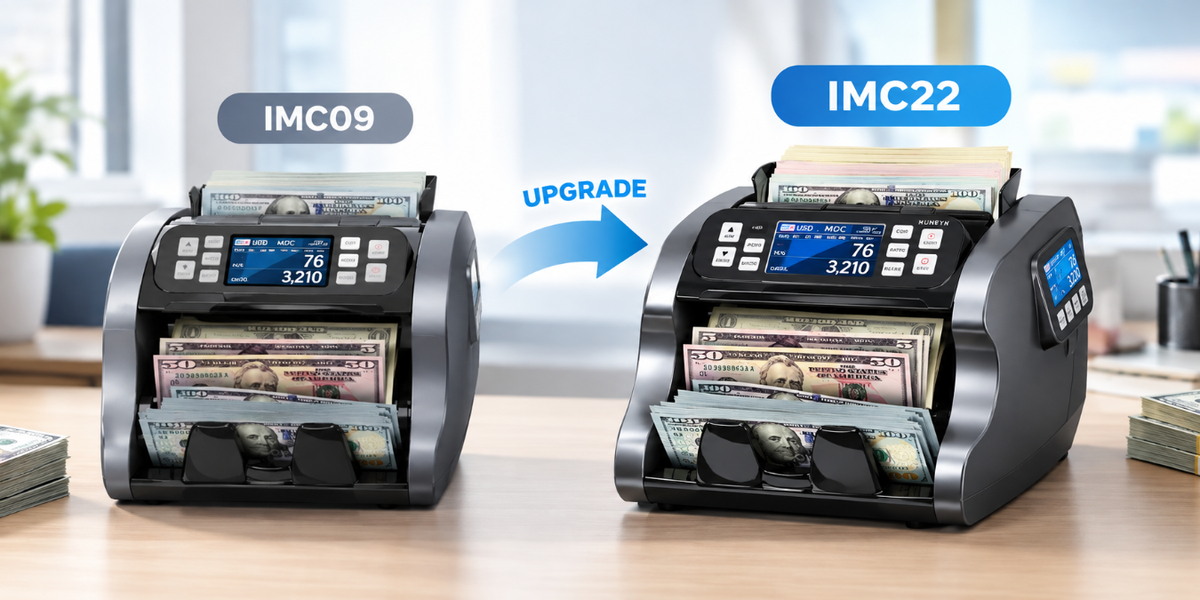
- MUNBYN IMC22: A mixed-denomination money counter with dual displays, designed for retailers that want faster cash reconciliation and clear counting results.
-
MUNBYN IMC08: A bank-grade mixed-denomination counter with a two-pocket design, advanced banknote verification, and sorting capabilities for businesses handling larger cash volumes.
The right choice depends on your workflow. Retailers that primarily need to count bills can consider simpler machines, while businesses that reconcile mixed bills, sort cash, and investigate suspicious notes may benefit from more advanced equipment. Explore the MUNBYN money counter machine collection to compare available models. Use the limited-time discount code "MYSEO6" at checkout to enjoy an extra 6% off on MUNBYN counters.
6 Features to Look for in a Retail Money Counter
1. Mixed-Denomination Counting
One of the most useful features for retail cash management is mixed-denomination counting. A traditional bill counter typically counts the number of banknotes in a stack. If the stack contains different denominations, the machine may report the total quantity without calculating the correct monetary value. Employees must then separate the bills and count each denomination individually.
A mixed-denomination money counter can recognize supported banknote denominations and calculate the total value automatically. For example, after a busy sales day, a cashier might have $20, $10, and $5 bills in the same stack. Instead of sorting the notes first, the cashier can use a compatible mixed-denomination counter to determine the total amount and denomination breakdown. This can help retailers:
- Reduce repetitive manual counting.
- Speed up register reconciliation.
- Prepare cash deposits more efficiently.
- Identify discrepancies between expected and actual cash totals.
Learn more in What Is a Mixed Denomination Money Counter?.
2. Counterfeit Detection
Cash-handling businesses need more than counting speed. They also need a consistent process for checking suspicious banknotes.
Depending on the machine, counterfeit detection may use ultraviolet (UV), magnetic (MG), infrared (IR), and contact image sensor (CIS) technologies. These methods examine different characteristics of banknotes, helping the machine identify notes that require additional inspection. Retailers should consider the detection technologies available, the currencies supported, and how the machine handles rejected notes.
However, no automated detector should be treated as a guarantee that every counterfeit will be identified. Employees should follow their store's cash-handling procedures and inspect suspicious bills when necessary. For a detailed explanation of these technologies, read Money Counter UV, MG, IR, and CIS Counterfeit Detection Explained.

3. Counting Speed and Hopper Capacity
A money counter's advertised speed is usually measured in bills per minute. While higher speeds can be useful, actual productivity also depends on how frequently employees need to reload the machine, remove counted bills, resolve feeding errors, and review results. Hopper capacity determines how many bills can be loaded at once. A larger hopper can reduce interruptions when counting substantial cash deposits. When comparing machines, evaluate these specifications together:
- Counting speed in the modes you actually use.
- Hopper capacity for loading uncounted bills.
- Stacker capacity for collecting counted bills.
- Ability to detect double feeds, half notes, or jammed bills.
- Ease of clearing errors and restarting a count.
A machine that runs quickly but requires frequent intervention may not deliver the best overall experience for a busy retail team.
4. Batch and Add Functions
Batch counting and add functions help retailers organize cash for different purposes.
- Batch counting allows employees to count notes in predetermined quantities, which can be useful when preparing cash drawers or organizing bills for deposits.
- Add mode combines successive counts into a running total. This is useful when a cash deposit contains more bills than the machine can comfortably process in one load.
Some machines offer both functions, allowing employees to count large amounts in smaller batches without losing track of the cumulative quantity. Before buying, check which modes are supported and whether they work with mixed denominations or only with specific counting settings.
5. Clear Displays and Easy Operation
A money counter should be easy for different employees to operate consistently. Clear displays, straightforward controls, and understandable error messages can reduce training time and prevent mistakes during busy shifts.
A dual-display design can be especially useful at a retail checkout or cash office because both the operator and a customer or supervisor can see the counting results. For retailers that reconcile cash with another employee, visible results also make it easier to review totals together.
6. Durability, Maintenance, and Support
A retail money counter may be used daily, so long-term reliability matters as much as its initial purchase price. Consider the machine's intended workload, warranty, software update options, cleaning requirements, and access to technical support. Dust, paper fibers, and worn banknotes can affect feeding and sensor performance over time.
Regular maintenance should follow the manufacturer's instructions. Employees should also know how to load bills correctly, clear jams safely, and handle notes flagged for inspection.
MUNBYN IMC22 vs. IMC08: Which Is Better for Retail?
MUNBYN offers both mixed-denomination counting solutions and more advanced machines for businesses with demanding cash-handling requirements. The IMC22 and IMC08 are worth comparing because they address different operational needs.
MUNBYN IMC22: For Everyday Retail Cash Reconciliation
The MUNBYN IMC22 Mixed Denomination Money Counter is designed for businesses that want to simplify routine cash counting.

Key features include:
- Mixed-denomination counting: Calculates the value and quantity of supported banknotes without requiring employees to sort every denomination first.
- Dual displays: A 3.5-inch TFT main display and a customer-facing display make counting results easier to view.
- Multiple detection technologies: CIS, UV, MG, IR, and MT technologies support banknote verification.
- Fast processing: The stated counting speed is up to 1,200 bills per minute, depending on the applicable mode and operating conditions.
- Currency flexibility: Additional supported currencies may be available through software upgrades.
For independent retailers, convenience stores, and businesses that regularly reconcile mixed cash, the IMC22 provides a practical balance of functionality and usability.
MUNBYN IMC08: For Higher-Volume Cash Handling
The MUNBYN IMC08 Bank-Grade Money Counter is designed for more demanding counting and sorting tasks.

Its key advantages include:
- Two-pocket design: The machine can direct selected or rejected banknotes into a separate pocket, helping reduce interruptions during processing.
- Mixed-value counting and sorting: It calculates the value of supported mixed denominations and offers sorting by denomination and other banknote characteristics.
- Advanced verification: Its detection system combines dual CIS sensors with additional banknote checks.
- Multiple counting modes: Mixed-denomination counting, sorting, batch counting, and add functions support different cash-management workflows.
- Higher-volume handling: The machine has a large loading capacity and a separate reject pocket for selected notes.
The IMC08 is worth considering for supermarkets, busy convenience stores, cash-intensive businesses, and retailers that need more than basic counting.
Quick Comparison
| Feature | MUNBYN IMC22 | MUNBYN IMC08 |
|---|---|---|
| Primary use | Routine retail cash reconciliation | More demanding counting and sorting |
| Mixed-denomination counting | Yes | Yes |
| Dual displays | Yes | Check the current configuration |
| Two-pocket design | Not the primary differentiator | Yes |
| Advanced banknote detection | Yes | Yes |
| Sorting capabilities | Check supported modes | Yes, with multiple sorting options |
| Best fit | Retailers prioritizing straightforward operation | Businesses prioritizing sorting and reduced interruptions |
Which should you choose? Choose the IMC22 if your priority is straightforward mixed-cash counting with visible results. Consider the IMC08 if you regularly process larger volumes and want a reject pocket to help manage exceptions without repeatedly stopping the count. Always confirm the current product specifications, supported currencies, and available functions before purchasing.
MUNBYN vs. Cassida: Which Money Counter Is Better for Retail?
Cassida USA is another brand retailers may encounter when comparing cash-counting equipment. Rather than choosing based on brand name alone, evaluate the specific models against your store's daily requirements.
| Buying consideration | MUNBYN | Cassida |
|---|---|---|
| Product selection | Offers money counters ranging from general-purpose models to advanced mixed-denomination machines | Offers a range of cash-handling products; capabilities vary by model |
| Mixed-denomination counting | Available on models such as the IMC22 and IMC08 | Confirm whether the specific model supports mixed-value counting |
| Counterfeit detection | Features vary by model, including multiple detection technologies on the IMC22 and IMC08 | Detection methods and capabilities vary by model |
| Sorting and rejected-note handling | The IMC08 includes a two-pocket design | Check the selected model's sorting and reject-pocket configuration |
| Customer-facing displays | The IMC22 includes a dual-display design | Compare display arrangements on individual models |
| Best comparison approach | Match features to your cash volume and workflow | Use the same criteria to assess the equivalent model |
The most important distinction is not which brand has the longest feature list. It is whether the particular machine solves your cash-handling problems at an appropriate cost.
For example, a retailer that only needs to count uniform stacks of bills may not need an advanced sorting machine. A business that frequently receives mixed denominations and processes large deposits may benefit from automated value calculation, stronger verification capabilities, and a separate reject pocket.
When comparing MUNBYN and Cassida, review the exact model specifications, warranty terms, supported currencies, operating modes, and maintenance requirements. Do not assume that two machines offer equivalent functions simply because both are described as money counters.
Bill Counter vs. Mixed-Denomination Counter: What Does Your Store Need?
A basic bill counter and a mixed-denomination counter serve different purposes. A basic bill counter is generally suitable when employees first separate banknotes by denomination and only need to verify the number of bills in each stack. It may be a sensible choice for businesses with relatively low cash volumes and simple reconciliation procedures.
A mixed-denomination counter is more useful when a stack contains different denominations and employees need the total monetary value. Depending on the model, it may also provide denomination breakdowns and additional sorting functions. The choice affects the entire cash-counting workflow. A lower-priced machine may meet your needs, but if employees must repeatedly sort bills manually, the time saved by the initial purchase could be limited.
Read Bill Counter vs. Mixed Denomination Counter to understand the differences before deciding. For a more detailed overview of operating modes, counting processes, and common applications, see What Is a Money Counter Machine and How Does It Work?.
How to Choose a Money Counter Based on Your Retail Business
Different retail environments have different cash-handling requirements.
- Small boutiques and independent shops: A basic counter may be sufficient if cash transactions are limited and employees already separate bills by denomination. If you want faster reconciliation of mixed bills, consider a mixed-denomination model such as the IMC22.
- Convenience stores and restaurants: These businesses may need to reconcile multiple cash drawers or prepare deposits frequently. Mixed-value counting, add mode, batch counting, and clear displays can make daily closing procedures more manageable.
- Supermarkets and high-volume retailers: Larger cash volumes increase the importance of processing capacity, reliable feeding, and exception handling. A two-pocket machine such as the IMC08 may be appropriate when sorting and rejected-note management are recurring tasks.
- Multi-location retail operations: Standardized cash-handling procedures can make it easier to compare results across locations. When selecting machines, consider ease of training, supported currencies, maintenance, and consistent reporting procedures.
Before purchasing, estimate your daily bill volume, identify the counting modes your employees actually need, and calculate how much time manual sorting currently takes. This gives you a more useful basis for comparing machines than speed or price alone.
Frequently Asked Questions
What is the best money counter for a small retail business?
The best option depends on transaction volume and counting requirements. A basic bill counter may be enough for stores that count sorted denominations. Businesses that regularly handle mixed bills may benefit from a mixed-denomination model such as the MUNBYN IMC22.
Is a mixed-denomination money counter worth the extra cost?
It can be, especially when employees frequently sort bills before counting them. Automated value calculation can reduce repetitive work and speed up reconciliation. Whether the additional cost is justified depends on cash volume, labor savings, and the features your store uses.
Can a money counter detect counterfeit bills?
Some money counters use UV, MG, IR, CIS, and other verification technologies to identify suspicious notes. Detection capabilities vary by model, and automated checks should complement—not replace—appropriate cash-handling procedures.
What is the difference between a one-pocket and a two-pocket money counter?
A one-pocket machine typically uses a single output stacker, so it may stop when a note requires attention. A two-pocket machine can direct selected or rejected notes to a separate pocket while continuing to process acceptable bills, depending on the model and operating mode.
How fast should a retail money counter be?
The right speed depends on your workload. A store counting a few small stacks per day may not need a high-speed machine. Businesses processing large deposits should also consider hopper capacity, sorting features, feeding reliability, and how often employees must intervene.
Do retail money counters support different currencies?
Some models support multiple currencies, but available currencies and mixed-currency counting capabilities vary. Confirm that your machine supports the banknotes you handle and check whether additional currency packages or software updates are required.
Final Thoughts
The best money counter for retail businesses is the one that fits your cash volume, improves reconciliation, and supports the level of verification your operation requires. For retailers seeking a straightforward way to count mixed denominations and display results clearly, the MUNBYN IMC22 is a strong candidate. For businesses with more demanding counting and sorting requirements, the IMC08 offers a two-pocket design and advanced banknote verification features.
Compare the available MUNBYN money counter machines, review the specifications of each model, and choose the machine that best matches your store's daily cash-handling workflow.

Share:
What Is a Mixed Denomination Money Counter?