


 United States
 Best Seller
 Label Printers
 All PDAs
 All Tablets
 All Thermal Labels
 Printer Accessories
 For businesses that handle cash every day, counting banknotes is only part of the job. Employees may also need to identify different denominations, calculate the total value of a cash stack, check suspicious bills, and reconcile cash drawers accurately. When bills of different values are mixed, manually sorting and counting them can take significant time and create additional opportunities for human error.
A mixed denomination money counter is designed to simplify this process. Also called a mixed bill counter, mixed value money counter, or currency discriminator, this type of machine can recognize different denominations in the same stack of banknotes and calculate their combined value.
Unlike a traditional bill counter that primarily counts the number of notes, a mixed denomination money counter combines high-speed counting with denomination recognition and, depending on the model, counterfeit detection and sorting capabilities.
What Is a Mixed Denomination Money Counter?
A mixed denomination money counter is a cash-counting machine that can process banknotes of different values in a single counting operation. For example, a stack may contain:
- 10 × $1 bills
- 5 × $5 bills
- 10 × $10 bills
- 20 × $20 bills
Instead of manually separating these bills before counting, a mixed denomination counter analyzes each note as it passes through the machine. It can then provide both the total number of bills and the total monetary value.
This makes mixed denomination counting particularly useful for businesses where employees regularly receive cash in different denominations, such as retail stores, restaurants, convenience stores, financial institutions, casinos, cash collection operations, and other cash-intensive businesses. If you are new to cash-counting technology, see MUNBYN's guide to What Is a Money Counter Machine and How Does It Work? for an overview of how modern money counters feed, count, identify, and process banknotes.
How Does a Mixed Denomination Money Counter Work?
Although different machines use different technologies, the basic process is straightforward.
1. Place the Mixed Bills in the Hopper
The operator places a stack of banknotes into the machine's hopper. Unlike a standard bill counter, the notes do not have to be separated by denomination first when the machine is operating in mixed denomination mode.
Properly positioning the bills is important because severely folded, damaged, stuck-together, or incorrectly aligned notes may affect feeding and recognition.
2. Feed the Bills Through the Counting Mechanism
Internal rollers separate and feed the banknotes one by one through the counting path. Sensors then collect information from each note. The machine keeps track of how many notes have passed through while simultaneously analyzing information that can help identify the denomination.
3. Identify the Denomination
Advanced mixed denomination counters use optical and image-based technologies to recognize the characteristics of individual banknotes. Depending on the machine and supported currency, the system may analyze elements such as:
- Note dimensions
- Printed patterns and images
- Magnetic characteristics
- Infrared characteristics
- Ultraviolet characteristics
- Security features
- Thickness and other physical characteristics
The machine's internal software then compares the information collected from the banknote with its stored currency data.
4. Calculate Quantity and Total Value
After identifying each note, the machine adds its value to the running total. For example, if a stack contains $1, $5, $10, and $20 bills, the machine can calculate the total value without requiring employees to manually sort every denomination.
Many professional machines can also provide a denomination breakdown, helping employees understand not only how much cash was counted but also how that total is distributed across different denominations.
5. Detect Suspicious or Counterfeit Bills
Many advanced mixed denomination money counters also incorporate multiple counterfeit detection technologies. Depending on the model, these may include UV, MG, IR, CIS, dimensional, and thickness detection. These technologies examine different characteristics of a banknote rather than relying on a single security check. For a deeper explanation of these technologies, read MUNBYN's guide to Money Counter UV, MG, IR & CIS Counterfeit Detection Explained.
It is important to understand that counterfeit detection capabilities vary between machines, currencies, and models. Businesses should always check the specifications and supported currencies of a particular machine before purchasing.

Mixed Denomination Counter vs. Standard Bill Counter
The main difference is what the machine counts. A standard bill counter is primarily designed to determine the quantity of banknotes. If you place 100 $20 bills into the machine, it can tell you that there are 100 bills. However, if $1, $5, $10, and $20 bills are mixed, a basic counter generally cannot determine the total monetary value without first sorting the bills.
A mixed denomination counter goes a step further by recognizing the value of individual notes.
| Feature | Standard Bill Counter | Mixed Denomination Money Counter |
|---|---|---|
| Counts number of bills | Yes | Yes |
| Handles same-denomination stacks | Yes | Yes |
| Handles mixed denominations | Limited | Yes |
| Calculates total monetary value | Usually no | Yes |
| Denomination recognition | Usually no | Yes |
| Counterfeit detection | Model dependent | Common on professional models |
| Manual sorting required | Often | Reduced or eliminated |
| Best suited for | High-volume single-denomination counting | Mixed cash processing |
For a more detailed comparison, see Money Counter vs. Counterfeit Detector. The two types of equipment solve different cash-handling problems and should not be treated as interchangeable.
What Are the Benefits of a Mixed Denomination Money Counter?
Faster Cash Processing
The most obvious advantage is speed. Employees do not need to separate every bill into individual denominations before calculating the total value. This can make a significant difference during busy periods, end-of-day cash reconciliation, or high-volume cash processing.
Reduced Manual Work
Manual sorting requires employees to organize, count, recount, and calculate cash repeatedly. A mixed denomination counter automates much of this process. Reducing repetitive counting tasks can also help employees focus on other responsibilities, such as customer service, inventory, or financial reconciliation.
More Consistent Results
Manual counting can be affected by fatigue, interruptions, and simple arithmetic mistakes. Automated counting provides a standardized process for every cash batch. For businesses that reconcile cash regularly, consistency can be just as important as speed.
Integrated Counterfeit Detection
Professional cash counters may combine denomination recognition with multiple counterfeit detection technologies. This means businesses can verify notes while counting instead of relying entirely on a separate manual inspection process. However, counterfeit detection should be considered an additional security measure rather than a guarantee.
Easier Cash Reconciliation
Knowing both the quantity and value of the cash can simplify end-of-day reconciliation. For example, instead of recording only that a drawer contains 250 bills, employees can identify the total monetary value and, depending on the machine, review the denomination breakdown.
Where to Use Mixed Denomination Money Counters
A mixed denomination money counter can be particularly useful when employees frequently handle different denominations together. Common applications include:
- Retail stores: Count cash drawers and daily deposits more efficiently.
- Restaurants and bars: Reconcile cash from multiple shifts.
- Convenience stores: Process mixed cash during busy periods.
- Banks and financial businesses: Handle larger volumes of banknotes.
- Casinos: Process cash efficiently while incorporating security checks.
- Cash-intensive businesses: Reduce repetitive manual counting.
- Fundraising organizations: Quickly process donations containing mixed denominations.
- Cash collection services: Improve the efficiency of cash reconciliation.
The right machine depends on transaction volume, currency requirements, denomination recognition needs, counterfeit detection requirements, and whether sorting is necessary.
What Should You Look for When Choosing a Mixed Denomination Money Counter?
Not every mixed bill counter provides the same capabilities. Consider the following factors before choosing a machine.
1. Currency Compatibility
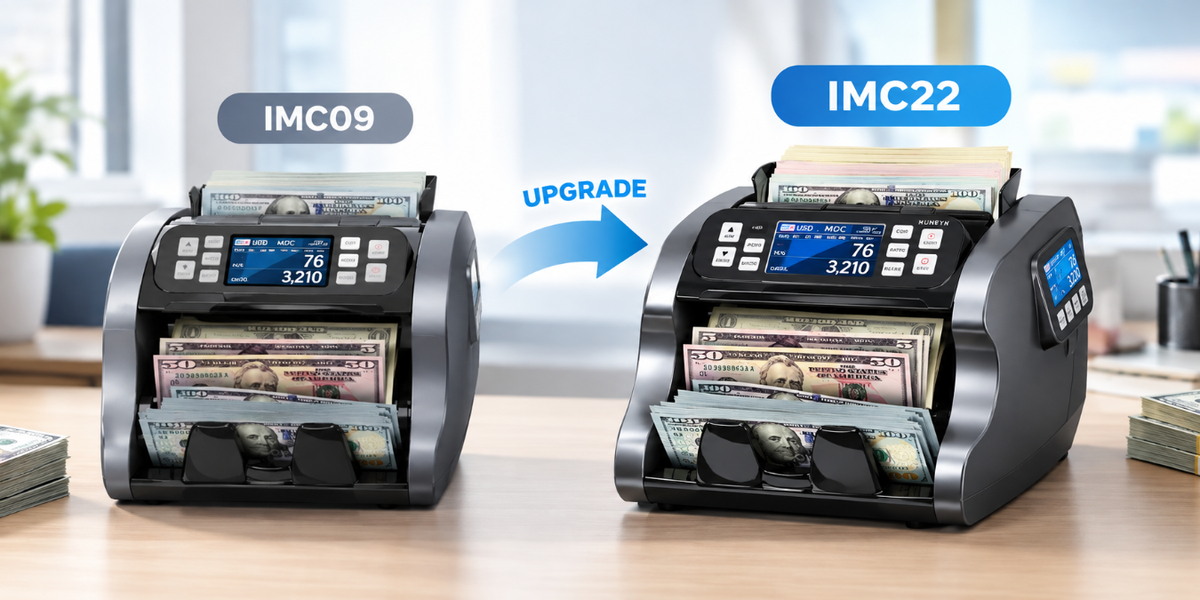
First, check whether the machine supports the currencies and denominations your business handles. Some professional models support multiple currencies and can receive software or currency updates as needed. MUNBYN's IMC22, for example, supports more than 120 currency upgrades, with availability depending on the applicable currency package.
2. Counting Speed
Counting speed is important for businesses that process large volumes of cash. A faster machine can reduce waiting time during deposits, shift changes, and end-of-day reconciliation. For example, the MUNBYN IMC22 is rated at up to 1,200 bills per minute and supports mixed-denomination counting.
3. Counterfeit Detection
Look at which detection technologies are included rather than simply assuming every money counter provides the same level of protection. Professional models may combine CIS, UV, MG, IR, thickness, and other detection methods.
4. Display and Usability
A clear display makes it easier for employees to monitor counting results. A dual-display design can also allow both the operator and customer to see the results. This can be particularly useful at retail counters and other customer-facing cash-handling environments.
5. Sorting Capability
If your business needs to separate bills by denomination, orientation, face, or rejection status, look for a machine with dedicated sorting capabilities rather than a counter that only calculates total value. For example, the MUNBYN IMC08 is designed for mixed-bill counting and sorting, with a second pocket that can divert selected or rejected bills while the main counting process continues.
MUNBYN Mixed Denomination Money Counters
MUNBYN offers a range of money counter machines designed for different cash-processing requirements, from everyday business counting to more advanced mixed-value processing and sorting.
MUNBYN IMC22 Mixed Denomination Money Counter

The MUNBYN IMC22 Mixed Denomination Money Counter is designed for businesses that need mixed-value counting, counterfeit detection, and clear operator/customer visibility.
It supports mixed denomination counting, automatic denomination recognition, multiple counterfeit detection technologies, and dual displays. MUNBYN specifies 11-layer detection and a counting speed of up to 1,200 bills per minute. This makes the IMC22 a practical option for retail stores, cash-intensive businesses, banks, and other organizations that need more than simple bill counting.
MUNBYN IMC01 Mixed Denomination Money Counter and Sorter
For businesses that need both value recognition and more advanced processing, the MUNBYN IMC01 Mixed Denomination Money Counter and Sorter provides mixed denomination counting and denomination breakdown capabilities.
MUNBYN IMC01 supports more than 120 currencies through installed currency packages and software updates and uses multiple detection technologies, including dual CIS sensors, UV, IR, magnetic, dimensional, thickness, and other checks.
MUNBYN IMC08 Bank-Grade Money Counter
For higher-volume professional cash processing, the MUNBYN IMC08 Bank-Grade Money Counter Machine adds mixed-denomination recognition and sorting functionality. Its second pocket can be used to divert selected or rejected notes, allowing businesses to handle exceptions without necessarily interrupting the entire counting process.
Is a Mixed Denomination Money Counter Worth It?
Whether you need a mixed denomination money counter depends primarily on how your business handles cash. If employees usually count large stacks of identical bills, a standard bill counter may be sufficient. But if your team regularly receives mixed denominations and needs to calculate total value, denomination breakdown, and counterfeit detection in one workflow, a mixed denomination money counter can eliminate several manual steps.
The key benefit is not simply counting faster. It is combining counting, denomination recognition, value calculation, and—on supported models—cash verification into a single process.
For businesses looking to improve cash-handling efficiency, explore the full range of MUNBYN Money Counter Machines and compare models based on counting speed, currency support, detection technology, sorting capability, and daily cash volume.

Frequently Asked Questions
1. Can a mixed denomination money counter count different bills at the same time?
Yes. A machine with mixed denomination counting capability can recognize supported denominations within the same stack and calculate the combined value.
2. Does a mixed denomination counter detect counterfeit money?
Many professional models include counterfeit detection technologies such as UV, MG, IR, and CIS. However, capabilities vary by model and currency, so check the manufacturer's specifications before purchasing.
3. Do I need to sort bills before using a mixed denomination counter?
Generally, no. Mixed denomination mode is specifically designed to process supported denominations together. However, bills should still be properly aligned and free from conditions that could interfere with feeding or recognition.
4. What is the difference between a money counter and a currency discriminator?
A basic money counter primarily counts the number of notes. A currency discriminator can identify different denominations and calculate their total value, making it better suited for mixed cash.

Share:
How to Print Shopify Shipping Labels: A Complete Guide