


 United States
 Best Seller
 Label Printers
 All PDAs
 All Tablets
 All Thermal Labels
 Printer Accessories
 If your business handles cash regularly, choosing the right cash management equipment can directly impact efficiency, accuracy, and security. Many business owners wonder whether they should invest in a money counter or a standalone counterfeit detector first.
At first glance, these two devices seem to solve different problems: a money counter helps you count bills faster, while a counterfeit detector helps identify fake currency. However, modern professional money counters have changed this equation. Many advanced money counters now combine high-speed counting with built-in counterfeit detection technology, allowing businesses to improve both efficiency and cash security with one machine.
For most businesses, the real question is no longer “money counter or counterfeit detector?” Instead, it is: what level of cash handling capability does your business actually need? This guide explains the differences between standalone counterfeit detectors and modern money counters, and helps you choose the right solution based on your business size, cash volume, and security requirements.
Understanding the Difference: Money Counter vs. Counterfeit Detector
A standalone counterfeit detector is designed for one specific purpose: verifying whether a bill is genuine. These devices typically use technologies such as ultraviolet (UV), magnetic ink detection (MG), infrared (IR), or image analysis to inspect security features on individual bills.
They are useful for businesses that occasionally need to check suspicious notes. Still, they have one major limitation: they do not solve the time-consuming process of counting large amounts of cash.
A money counter, on the other hand, is designed to improve the entire cash-handling workflow. Instead of manually counting stacks of bills, employees can process hundreds or thousands of notes per minute with improved accuracy. More importantly, many modern money counters now include built-in counterfeit detection systems.
For example, MUNBYN professional money counters combine counting speed with multiple authentication technologies. Depending on the model, features may include CIS image recognition, UV detection, magnetic detection, infrared detection, thickness measurement, and other security checks to identify suspicious bills during the counting process. This means businesses no longer need to choose between speed and security—they can get both from a single machine.
What Problems Does Each Solution Solve?
The Role of a Money Counter
A money counter primarily solves an efficiency problem. Manual cash counting takes valuable employee time and creates opportunities for human errors. For businesses handling hundreds or thousands of bills daily, even a few minutes saved per transaction can translate into significant labor savings over time.
A professional money counter can help businesses:
- Count large volumes of bills within minutes
- Reduce manual counting mistakes
- Process mixed denominations automatically
- Create consistent cash management procedures
- Improve end-of-day reconciliation efficiency
Modern models also offer advanced functions beyond basic counting, including:
- Batch counting for preparing deposits or cash drawers
- Mixed denomination counting for calculating total value
- Sorting functions for organizing bills
- Automatic detection of suspicious or damaged notes
For growing businesses, a money counter becomes not just a counting device but a complete cash management tool.
The Role of a Standalone Counterfeit Detector
A standalone counterfeit detector still has value, especially in specific situations. Businesses that may benefit from a dedicated counterfeit detector include:
- Small vendors processing occasional cash payments
- Businesses that receive unusual or high-risk transactions
- Employees who need a quick secondary verification tool
- Locations where only a few bills require inspection
However, standalone detectors are generally not designed for high-volume cash processing. Checking hundreds of bills individually can slow operations and add an extra step to the workflow. For businesses that count cash every day, investing only in a counterfeit detector often leaves the biggest operational challenge—the counting process—unsolved.
Why a Modern Money Counter Is Usually the Better First Investment
For most retail stores, restaurants, service businesses, and cash-based operations, a money counter provides a higher return on investment because it solves multiple problems at once. A modern cash counter can help reduce:
1. Labor Costs
Employees no longer need to spend extended periods manually counting bills. Faster processing allows staff to focus on customer service and other operational tasks.
2. Counting Errors
Human counting mistakes can lead to cash discrepancies, especially during busy periods or shift changes. Automated counting improves consistency and accuracy.
3. Counterfeit Risks
Instead of checking bills separately, businesses can detect suspicious currency while counting. This creates a smoother and more secure workflow.
4. Cash Management Complexity
Advanced models can organize bills, calculate totals, and prepare cash for deposits, making daily financial operations easier.
Choosing the Right MUNBYN Money Counter for Your Business
Not every business needs the same level of cash-handling capability. The right choice depends on your transaction volume, operational requirements, and security needs.
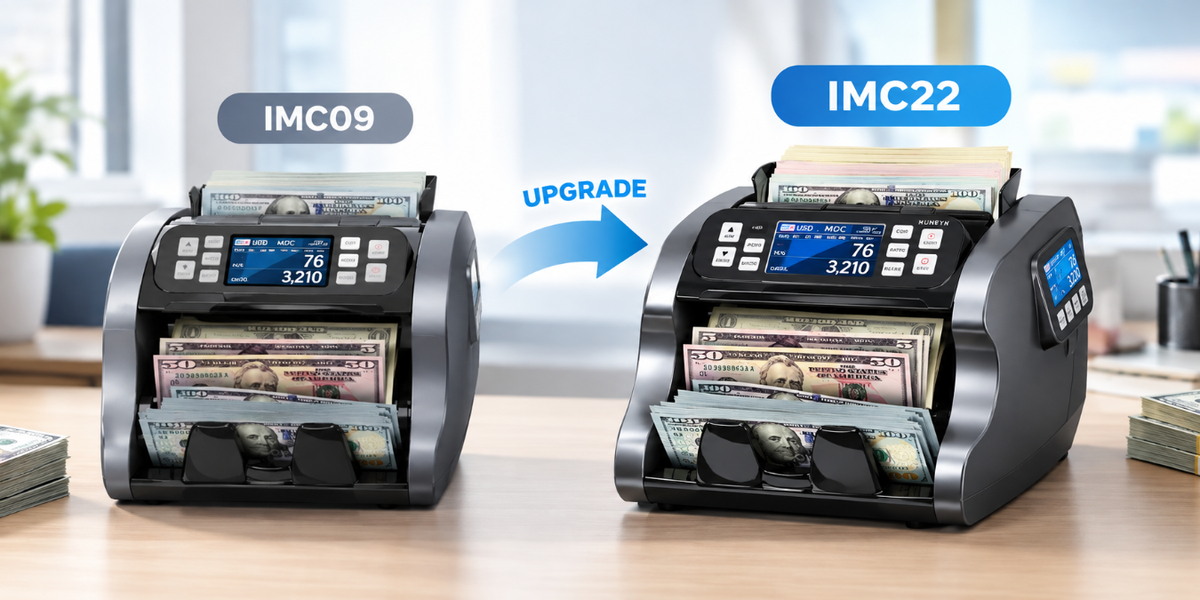
Best for Small and Medium Businesses: MUNBYN IMC22 Mixed Denomination Money Counter

For retail stores, restaurants, convenience stores, and businesses that need efficient daily cash processing, the MUNBYN IMC22 offers a strong balance between performance, usability, and transparency. The IMC22 features:
- Mixed denomination counting
- Automatic denomination recognition
- Up to 1,200 bills per minute counting speed
- Dual LED displays for operator and customer visibility
- Professional CIS counterfeit detection
- Multiple security checks including UV, MG, IR, and image recognition technology
One standout feature is the dual-display design. The main screen allows employees to monitor results, while the customer-facing display allows customers to view counting results in real time. This makes the IMC22 especially useful for:
- Retail checkout counters
- Cashier stations
- Currency exchange businesses
- Restaurants and hospitality businesses
The dual-display system improves transparency and helps build customer trust during cash transactions.
Best for High-Volume Operations: MUNBYN IMC08 Bank-Grade Money Counter

For businesses handling large amounts of cash every day, the MUNBYN IMC08 is designed for professional-level performance.
Unlike entry-level counters, the IMC08 is built for demanding environments such as banks, casinos, large retail stores, supermarkets, and high-volume cash processing centers. The IMC08 includes:
- Bank-grade mixed denomination counting
- Dual CIS sensors
- Two-pocket sorting system
- Up to 1,200 bills per minute counting capability
- 12 counterfeit detection methods
- Automatic sorting of suspicious or damaged bills
- Support for multiple currencies with software upgrades
The two-pocket design is particularly valuable for businesses that cannot afford interruptions. Instead of stopping whenever the machine detects a suspicious or damaged bill, the IMC08 can separate those notes into a different pocket while continuing the counting process. For organizations where cash volume is high and downtime is expensive, this professional workflow can significantly improve efficiency. Learn more about: Top Bank-Grade Money Counters with Counterfeit Detection 2026
When Should You Still Buy a Standalone Counterfeit Detector?
Although modern money counters include counterfeit detection, a standalone detector can still be useful as a secondary tool. Consider adding one if:
- Your business frequently receives large-value bills
- Employees regularly handle cash outside the main counting area
- You operate in a high-risk environment
- You need quick verification during customer transactions
For example, a retail store may use a money counter during closing procedures while keeping a small counterfeit detector near the register for immediate checks. The two tools can work together, but the money counter should usually come first for businesses that process cash regularly.
Common Buying Mistakes to Avoid
Mistake 1: Buying Only Based on Price
The cheapest machine may handle basic counting but lack the detection technology, speed, or reliability needed for your business. Instead, consider your daily cash volume and future growth.
Mistake 2: Choosing More Features Than You Need
A professional two-pocket sorter may be unnecessary for a small retail store, while a basic counter may not handle the needs of a busy supermarket. Choose equipment based on your workflow.
Mistake 3: Ignoring Counterfeit Detection Features
Not all money counters offer the same level of security. If counterfeit protection matters, check whether the machine includes technologies such as CIS, UV, MG, IR, and other authentication methods.
Mistake 4: Forgetting Maintenance
Regular cleaning and maintenance are essential for keeping sensors accurate and extending machine life.
Final Recommendation
For most businesses, buying a standalone counterfeit detector first is no longer the most practical approach. Modern money counters combine the two most important cash-handling functions: speed and security.
If you run a small or medium-sized business that needs reliable daily cash processing, the MUNBYN IMC22 provides an excellent balance of mixed-denomination counting, counterfeit detection, and customer transparency. If your business handles high cash volumes and requires professional-grade performance, the MUNBYN IMC08 delivers advanced sorting capability, bank-level detection, and continuous operation efficiency.
The best investment is not simply the machine with the most features—it is the solution that matches your cash-handling needs today while supporting your business growth tomorrow. Use the limited-time discount code "MYSEO6" at checkout to enjoy an additional 6% off your items.
FAQs
Q1: Can MUNBYN money counters detect counterfeit bills?
Yes. Many MUNBYN money counters include built-in counterfeit detection technologies such as CIS, UV, MG, and IR detection. Professional models like the IMC08 provide additional authentication methods for higher-security applications.
Q2: Do I need a separate counterfeit detector if I buy a money counter?
Usually, no. For most businesses, a money counter with built-in counterfeit detection provides sufficient protection. A standalone detector is mainly useful as a secondary verification tool.
Q3: Which is better for a small business: IMC22 or IMC08?
The IMC22 is ideal for small and medium businesses that need fast counting, mixed denomination recognition, and customer-facing transparency. The IMC08 is better suited for high-volume businesses requiring advanced sorting and professional-grade cash processing.
Q4: How fast can MUNBYN money counters process bills?
Depending on the model, MUNBYN money counters can process up to 1,200 bills per minute while maintaining high counting accuracy.
Q5: Can a money counter replace manual cash counting?
Yes. A professional money counter significantly reduces the time employees spend counting cash while improving accuracy and consistency.

Share:
MUNBYN vs Rollo: Which Shipping Label Printer Should You Choose
Best Restaurant Food Label Printers for Commercial Kitchens