


 United States
 Best Seller
 Label Printers
 All PDAs
 All Tablets
 All Thermal Labels
 Printer Accessories
Counterfeit currency losses cost businesses billions every year — and the problem hasn't slowed down in 2026. Whether you're running a busy retail store, managing a casino cage, or working a bank teller window, manually checking bills is no longer practical. A bank-grade money counter with built-in counterfeit detection does the job faster, more reliably, and without human error.
But "bank-grade" gets thrown around a lot in product listings. What does it actually mean, and which machines are worth your money this year? Here's a straight-talking guide to the best options on the market right now.
What "Bank-Grade" Actually Means
The term sounds impressive, but it refers to specific technical capabilities. A true bank-grade money counter should:
- Detect counterfeits using multiple methods simultaneously — not just UV light alone
- Read mixed denominations automatically without pre-sorting
- Count at speeds of at least 1,000 bills per minute
- Support regular currency database updates as new bills enter circulation
- Provide reliable error detection for torn, folded, or chained bills
The most rigorous machines combine UV (ultraviolet), MG (magnetic ink), IR (infrared), MT (magnetic thread), and CIS (contact image sensor) technology. Using just one or two of these leaves leaves gaps that sophisticated counterfeiters can exploit.
The Shift Toward Multi-Currency and Mixed Denomination Counting
A few years ago, most money counters were designed to count single denominations — you'd sort your bills by value first, then run each stack through the machine. That workflow made sense when machines were simpler, but it's increasingly seen as a bottleneck.
In 2026, the clear trend is toward mixed denomination counting (MDC), where the machine automatically recognizes and tallies each denomination as it processes a mixed stack of bills. For retailers dealing with end-of-day cash reconciliation or businesses with international customers, this saves significant time.
Pair that with multi-currency support — some machines now handle 120+ currencies — and you have a device that's genuinely useful across different markets without reprogramming.
4 MUNBYN Money Counters Worth Considering in 2026
MUNBYN has emerged as one of the more trusted names in this space, particularly because its machines offer bank-grade detection layers at price points that don't require a capital expenditure request. Here's a breakdown of their current lineup.
1. MUNBYN IMC01 — Best Entry Point for Small Businesses

If you're a small business owner who handles a moderate volume of cash and wants solid counterfeit detection without spending four figures, the IMC01 hits a reasonable balance. It supports mixed-denomination counting and sorting, with UV, MG, and IR detection covering the basics.
It's a good fit for coffee shops, small retailers, or any setting where you're not running thousands of bills per day but still want confidence that what you're accepting is genuine. Starting from $509.99 (During the Ninth Anniversary Event of MUNBYN), it's the most accessible point of entry into MUNBYN's money counter range.
2. MUNBYN IMC08 — The Bank-Grade Workhorse

The IMC08 is the machine that earns the "bank-grade" label without asterisks. It's built for high-volume, high-stakes environments. It comes with 12 counterfeit detection methods — including dual CIS sensors that scan bills at high resolution for image-based verification alongside the standard UV/MG/IR/MT suite.
It supports over 120 currencies, making it genuinely useful for currency exchanges, international businesses, and banks handling foreign notes. The two-pocket design means it can sort bills continuously without stopping — rejected or flagged bills go to a separate pocket while valid bills stack cleanly in the other.
Lifetime software updates are included, which matters more than people realize. Currency databases need refreshing when new bill versions enter circulation, and a machine that can't update quickly becomes a liability rather than an asset.
It's a significant investment — but for a bank branch, hotel front desk, or large retail operation processing hundreds of thousands of dollars per month, the accuracy and speed justify it.
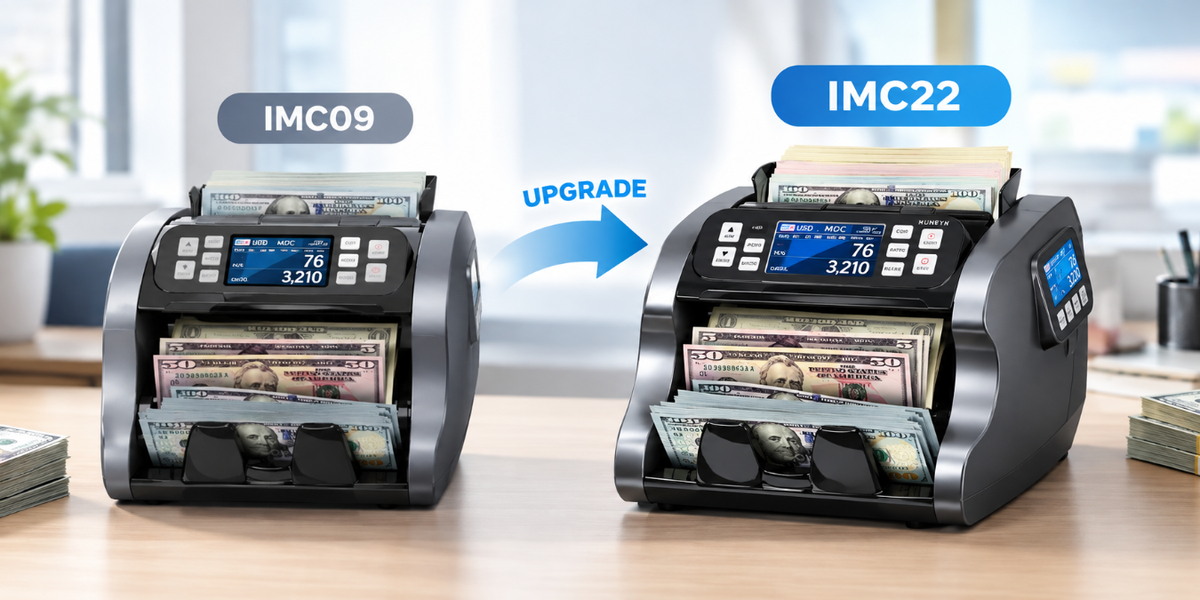
3. MUNBYN IMC22 — Mixed Denomination with Dual Display

The IMC22 sits comfortably in the mid-range, designed around one specific convenience that operations managers appreciate: a dual LED display. Both the operator and a customer or supervisor can view the count simultaneously, which cuts down on disputes and speeds up verification in customer-facing settings.
It handles mixed denomination recognition automatically and runs UV, MG, and IR detection. Available in black or white, it's a practical choice for restaurants, pharmacies, or any business where transparency during the counting process matters.
4. MUNBYN IMC40 — 2-Pocket Design for Non-Stop Counting

The IMC40 is built for environments where downtime is not an option. The two-pocket architecture allows continuous counting and sorting — suspect bills are automatically diverted to a separate reject pocket without interrupting the count. For casinos, armored car services, or bank back-offices, this is exactly the kind of uninterrupted throughput that matters.
It features dual CIS sensors for high-resolution image scanning, supports mixed denomination and value counting, and includes ADD and BATCH modes for flexible counting workflows. The built-in thermal printer is a notable addition: you get a physical receipt of each count session, which is invaluable for audit trails and reconciliation records.
What to Look For Beyond Detection Technology
The sensor suite matters, but a few other factors often get overlooked when buyers are comparing specs:
Hopper capacity determines how many bills you can load before the machine needs to be refilled. Machines with 200-bill hoppers work fine for low-volume settings; high-volume operations should look for 500-bill hoppers.
Counting speed ranges from 800 to 1,500 bills per minute across different models and modes. MDC mode typically runs slower than straight count mode — that's normal, since the machine is doing more work.
Reject pocket — a separate output for flagged bills — is essential for any serious operation. Without it, you have to manually review the full output stack to find the suspect bill.
Software update support is a practical necessity. Any machine that can't receive currency database updates will eventually fall behind as new note versions roll out.
Display clarity matters more than you'd think in real-world conditions. Dual displays, large LED readouts, and clear denomination breakdowns reduce the chance of misreading a count under busy conditions.
The Bottom Line
In 2026, there's no excuse for relying on a basic UV pen to catch fakes. A genuine bank-grade counter with multi-layer detection — UV, MG, IR, MT, and CIS — is now accessible at a range of price points, from modest single-pocket machines to high-speed dual-pocket sorters with built-in printers.
MUNBYN's lineup covers that full range. Whether you're buying your first money counter for a small shop or upgrading to a two-pocket bank-grade machine for serious volume, MUNBYN's full money counter collection is worth a look. All models include lifetime software updates — which, for a device built to keep pace with evolving currency security features, is not a small thing. (Use the discount code "MYSEO" at checkout to enjoy an additional 8% off for MUNBYN money counters!)

Share:
9 Years of Innovation: Why Small Businesses Trust MUNBYN Label Printers
What Is an AI Sticker Printer? Everything You Need to Know